


Is Finland following the Nobel playbook? If so, why isn’t it working?
Finland has inclusive institutions, high trust, strong property rights, and women participating in the workforce at rates exceeding other developed countries. According to recent Nobel Prize-winning economists, these appear to be the ingredients for long-term prosperity.
So why has growth stagnated in Finland? What can be done about it?
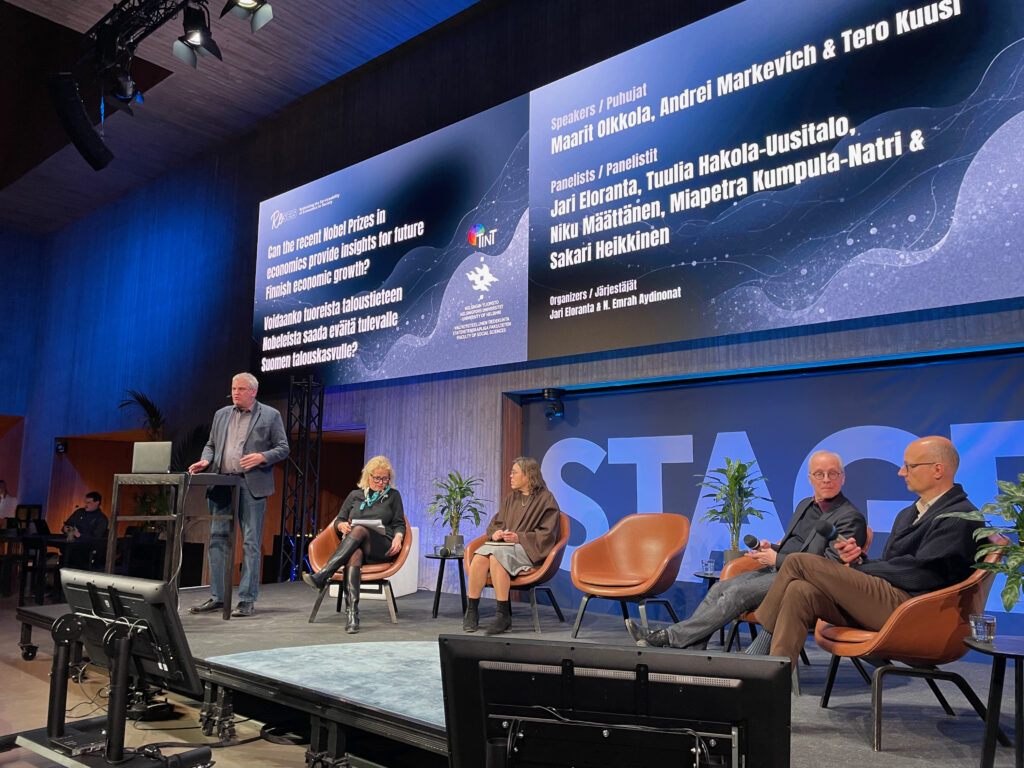
On January 29, 2026, Jari Eloranta and N. Emrah Aydinonat brought together economists and policymakers at Tiedekulma in Helsinki to discuss whether Nobel insights can help diagnose Finland’s economic challenges.

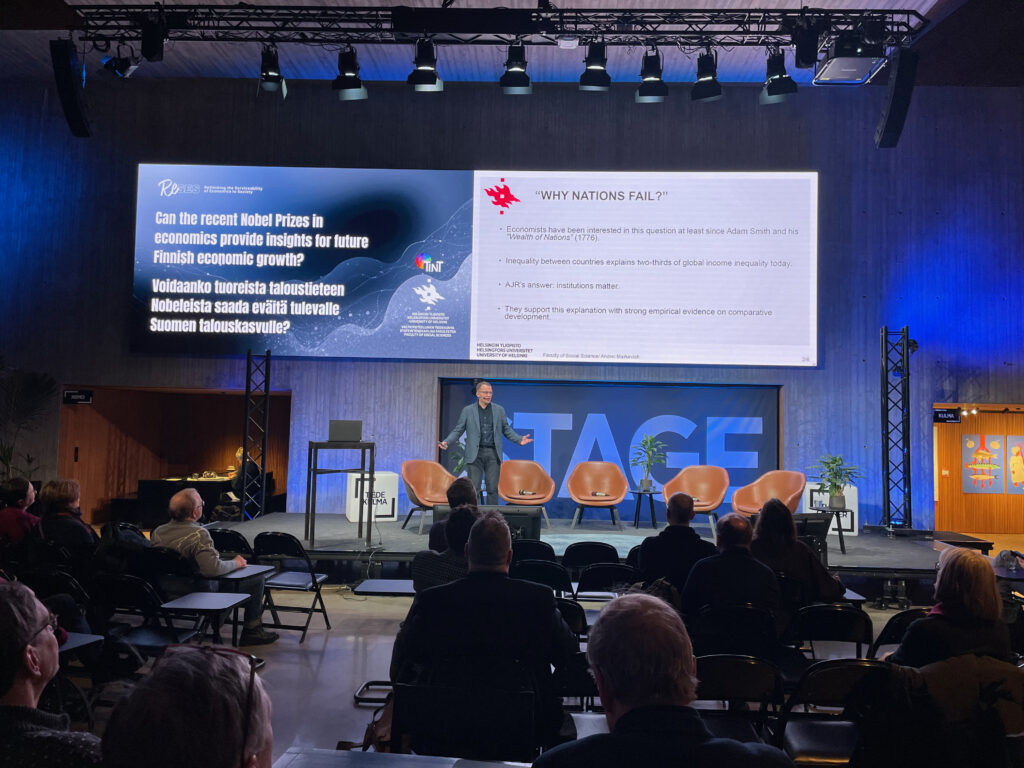
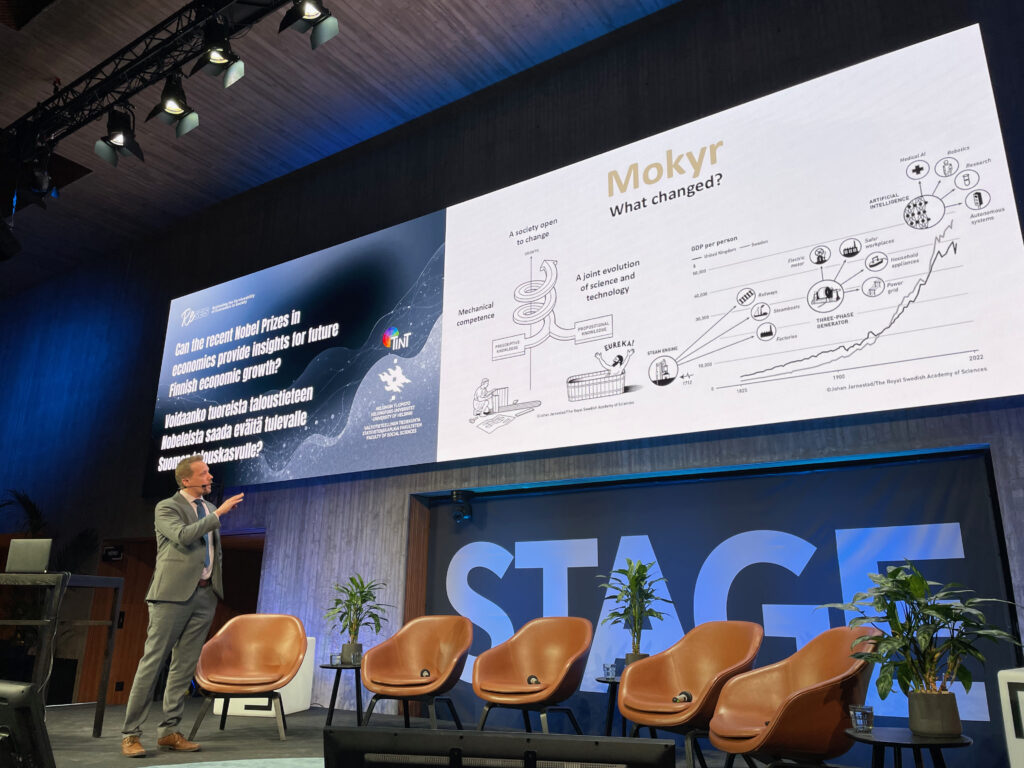
The three short presentations on the most recent Nobel Prizes set the stage. Maarit Olkkola (VATT) outlined Claudia Goldin’s (2023 Nobel Laureate) research on gender gaps and the persistent “child penalty” in women’s earnings. Andrei Markevich (University of Helsinki) applied Acemoglu, Johnson, and Robinson’s (2024 Nobel Laureates) institutional theory to Finland’s 20th-century success and asked whether slow growth now threatens that foundation. Tero Kuusi (ETLA) presented Mokyr, Aghion, and Howitt’s (2025 Nobel Laureates) work on innovation and creative destruction, noting that AI may represent the next major technological wave.
Then came the panel discussion on the possible lessons these scholars have suggested —and it was frank, lively, and occasionally opinionated.
Some Highlights from the Evening
Is Finland’s “17 years of stagnation” a myth? Professor Niku Määttänen argued that Finland’s pre-2008 economy wasn’t a normal baseline. It was “fabulous luck” driven by the Nokia boom. Remove that anomaly, and Finland’s growth looks steady rather than collapsed. Are we comparing Finland’s current economic performance to an unrepeatable peak?
Is Finland “sawing off its own leg” on immigration? MP Miapetra Kumpula-Natri criticized the three-month rule requiring foreign-trained experts to leave if unemployed. Research shows only one-third of Finnish innovations come from Finns alone. The rest involve international talent that current policy discourages.
Don’t expect defense spending to boost the economy. Professor Emeritus Sakari Heikkinen cautioned against the idea that military investment will generate economic spillovers: it rarely does. Professor Jari Eloranta concurred, noting that defense spending has complex impacts.
Is the public sector blocking economic growth? Määttänen suggested that some Finnish institutions appear to protect insiders at the expense of the services they provide. Can this be a reason behind slow economic growth? Is the public sector too dominant in Finland? Can this stifle efficiency?
Is R&D money being “splashed” without a plan? VATT Director General Tuulia Hakola-Uusitalo warned that Finland is increasing innovation funding too fast, without the implementation capacity to use it well.
Did industrial policy thinking stopped in Finland, in the 1990s. Audience member Timo Hämäläinen from SITRA argued that Finland hasn’t systematically developed new growth sectors since the Nokia era, which itself was the product of deliberate 1980s coordination that today’s policymakers have forgotten.
Reasons for Optimism
The panelists agreed that Finland’s younger generation shows a stronger entrepreneurial spirit and “hunger for success” than previous cohorts. The startup ecosystem is growing. And Heikkinen reminded the audience that Finland’s self-perception tends toward dramatic swings—from “Japan of the North” to “the next Greece.” Perhaps a steadier view as “a decent Nordic country” making continuous improvements would serve better.
Watch the Full Discussion
This summary captures highlights, but the three presentations connecting Nobel research to Finnish challenges, full 90-minute discussion, and a lively audience contribution is worth watching in full.
Watch on YouTube: “Can the recent Nobel Prizes in economics provide insights for future Finnish economic growth?“
Panel: Jari Eloranta (chair), Miapetra Kumpula-Natri, Tuulia Hakola-Uusitalo, Sakari Heikkinen, and Niku Määttänen. Presentations by Maarit Olkkola (VATT), Andrei Markevich (University of Helsinki), and Tero Kuusi (ETLA).